
Table of Contents
- Why Professional Agile Delivery Frameworks Matter
- Agile Project Management Playbooks: Building Your Foundation
- Agile Delivery Best Practices for Real-World Teams
- Agile Implementation Templates: Ready-to-Use Resources
- Professional Agile Delivery Frameworks: What to Look For
- Making the Investment Decision
- Conclusion
- Frequently Asked Questions
Last Updated: September 3, 2026
Why Professional Agile Delivery Frameworks Matter
Most teams don't fail because they lack effort. They fail because they lack structure. Without a clear framework guiding how work flows through the team, even the most talented people spend energy on coordination instead of delivery.
This is where professional agile delivery frameworks become essential. They provide the operational blueprint that transforms individual effort into predictable, repeatable results. Whether you're scaling a small product team or orchestrating delivery across multiple departments, the right framework eliminates guesswork and creates clarity.
At Agile Toolkit, we've spent years working with teams that faced exactly this challenge. They had the people, the budget, and the commitment. What they lacked was the structured approach to turn those assets into consistent output. That's when professional agile delivery frameworks shift from nice-to-have to business-critical.
The question isn't whether you need a framework. The question is which one fits your actual situation, and how to implement it without disrupting the work already underway.
Agile Project Management Playbooks: Building Your Foundation
An agile project management playbook is your operational manual. It documents how your team makes decisions, prioritises work, runs ceremonies, and handles the unexpected. Without one, every new team member learns differently, and every crisis gets handled inconsistently.
The best playbooks aren't theoretical. They're built on real-world constraints: your actual sprint length, your team size, your deployment frequency, and the types of work you actually do. A playbook designed for a five-person startup will break when scaled to fifty people. A playbook built for continuous support work won't work for product development with fixed-length sprints.
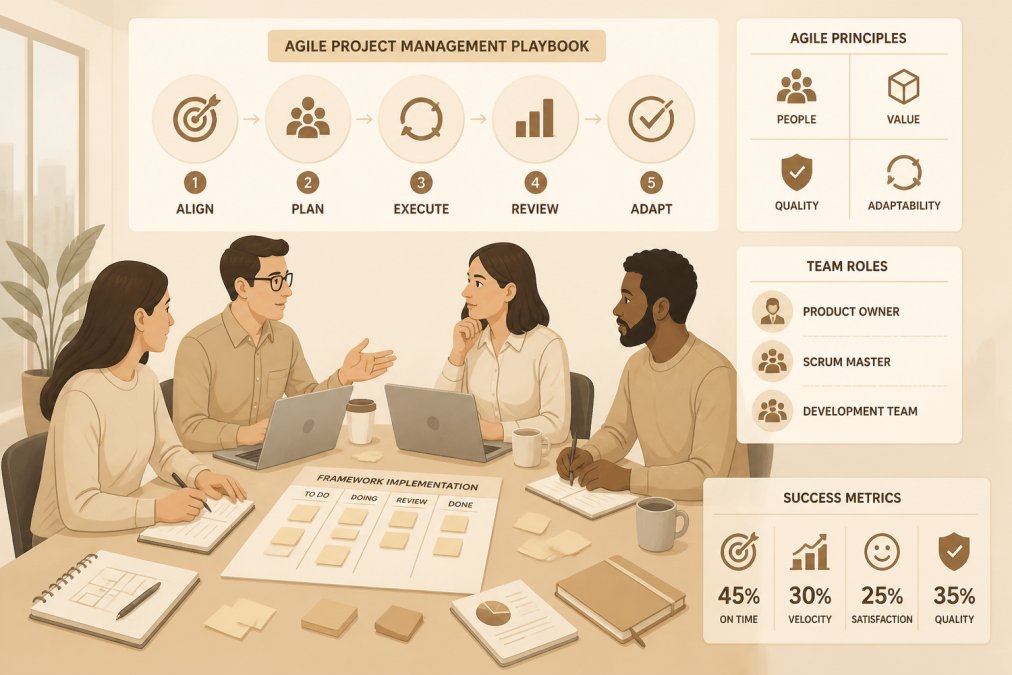
When building your playbook, focus on these core elements. First, define your ceremonies: what meetings happen, who attends, how long they run, and what decisions get made in each. Second, establish your workflow: how work moves from idea to done, what gates exist, and who approves transitions. Third, document your roles: not job titles, but the specific responsibilities that need to exist for the framework to function.
Many teams skip the playbook step and jump straight to tools. They implement Jira, assign roles, and expect the framework to emerge. It doesn't. Tools amplify a good playbook and make a bad one worse. Without clarity on how work should flow, teams use tools to document chaos rather than prevent it.
The Agile Toolkit approach focuses on playbooks that address your specific challenges. Whether you're managing continuous support work or sprint-based development, whether your team is co-located or distributed, the playbook adapts to your context rather than forcing your context to adapt to a generic template.
Agile Delivery Best Practices for Real-World Teams
Best practices exist because they've been tested repeatedly across different contexts. But "best" is contextual. What works for a team of eight won't work for a team of eighty. What works for teams shipping weekly won't work for teams shipping quarterly.
The most reliable best practices focus on principles rather than prescriptions. For example, the principle of "make work visible" applies everywhere. How you make work visible, a physical board, a Jira dashboard, a spreadsheet, depends on your team's size and distribution. The practice adapts; the principle holds.
Several practices apply across almost all agile environments. First, timebox your ceremonies ruthlessly. A standup that runs thirty minutes destroys more value than it creates. A planning session that sprawls into hours signals that your backlog isn't ready. Second, separate planning from execution. Your team shouldn't be deciding what to do while they're doing it. Third, measure cycle time, not velocity. Cycle time tells you how fast work actually moves through your system. Velocity tells you how much work you committed to.
Fourth, establish a clear definition of done. This is non-negotiable. If "done" means different things to different people, you'll ship incomplete work, create technical debt, and confuse your stakeholders about what's actually finished. Fifth, create a sustainable pace. Teams that burn out deliver less, not more. The best teams work at a pace they can maintain for years.
A common mistake is assuming that implementing these practices requires a massive change. You don't need to reorganise your entire operation. Start with one practice, measure the impact, then add the next.
Agile Implementation Templates: Ready-to-Use Resources
Templates accelerate adoption because they give teams a starting point. Rather than building everything from scratch, you inherit the structure and adapt it to your context. This is far faster than designing from first principles.
Effective templates cover the core workflows: sprint planning, backlog refinement, retrospectives, and release planning. They include decision criteria, role descriptions, and the specific questions to ask at each stage. They also include the artefacts: sprint goals, acceptance criteria, retrospective formats, and metrics to track.
The value of a template isn't that it's perfect. It's that it's functional on day one and improvable from there. A team using a mediocre template and iterating on it will outpace a team designing the perfect framework but never implementing it.
When selecting templates, look for ones that include examples. Examples show you how the template works in practice, not just in theory. They answer the question: "What does this actually look like when we use it?" Templates without examples often sit unused because teams don't understand how to apply them.
Agile Toolkit provides templates that come from real implementations. The Agile Playbook & Scrum Master Toolkit includes Jira templates, ceremony formats, and decision frameworks that teams can deploy immediately. Rather than starting blank, you start with a structure that's already proven to work.

Professional Agile Delivery Frameworks: What to Look For
When you're evaluating professional agile delivery frameworks, several factors matter. First, alignment with your work type. Are you doing continuous support work, sprint-based development, or a mix? Kanban excels at continuous flow. Scrum works well for fixed-scope sprints. Many teams need both.
Second, scalability. The framework should work for your team now and scale to your team in two years. A framework that requires complete redesign when you grow from ten to twenty people isn't sustainable.
Third, clarity on roles. Who owns what decisions? Who facilitates ceremonies? Who removes blockers? Ambiguity on roles creates friction and delays. The framework should make roles explicit.
Fourth, integration with your tools. Your framework should work with the systems you're already using, not require you to replace everything. If you're using Jira, the framework should tell you how to structure your Jira instance. If you're using Azure DevOps, it should work there.
Fifth, flexibility. The best frameworks acknowledge that context varies. They provide the core structure and give you permission to adapt the details. A framework that demands rigid compliance will fail the moment your context changes.
Finally, support for continuous improvement. The framework should include practices for retrospectives and iteration. If the framework is static, it becomes outdated as your team evolves.
The Kanban vs Scrum Decision Matrix Guide helps teams choose between these two primary approaches based on their specific constraints. For teams needing both, the Scrum vs Kanban Playbook shows how to run hybrid models that combine the strengths of each.

Making the Investment Decision
Investing in professional agile delivery frameworks is an investment in operational efficiency. The question isn't whether you can afford to buy frameworks. It's whether you can afford not to.
Teams without structured frameworks waste time on coordination. They repeat mistakes because there's no mechanism to capture and act on lessons learned. They struggle to onboard new people because there's no documented way of working. They ship inconsistently because there's no clear definition of done.
The cost of these inefficiencies compounds over time. A team that wastes ten percent of its capacity on coordination waste loses that ten percent every sprint, every year. Over two years, that's the equivalent of losing a full team member's output.
Professional agile delivery frameworks from Agile Toolkit address this directly. The Agile Ops & Scaling Bundle includes five guides covering automation, quality standards, scaling practices, and team operations. At £29.99, it's a fraction of what you'd spend on a single consultant day, yet it provides the operational structure that consultants would recommend.
The Kanban vs Scrum Decision Matrix Guide (£8.99) helps you choose the right framework for your context. The Scrum vs Kanban Playbook (£8.99) shows you how to implement the framework you choose. The Agile Playbook & Scrum Master Toolkit (£8.99) provides the templates and tools your team needs on day one.

The real question is implementation. Buying a framework is easy. Using it is harder. The best frameworks include examples, templates, and implementation guidance. They acknowledge that adoption takes time and provide the scaffolding to make adoption easier.
Conclusion
Professional agile delivery frameworks aren't luxury items for large enterprises. They're essential infrastructure for any team serious about consistent delivery. They eliminate the friction that slows teams down. They create clarity about roles, decisions, and processes. They give you a foundation to build on as your team grows.
The challenge most teams face isn't choosing between frameworks. It's implementing the framework they choose without disrupting the work already underway. This is where ready-to-use resources make the difference. Rather than designing from scratch, you start with a proven structure and adapt it to your context.
Agile Toolkit provides the professional agile delivery frameworks your team needs to move from chaos to clarity. The Scrum.org framework definitions offer foundational guidance, but they require interpretation. Agile Toolkit translates that guidance into playbooks, templates, and decision frameworks your team can use immediately. Start with the Agile Alliance's implementation resources for broader context, then move to tools that give you the specific structure your team needs.
The frameworks you choose today determine how efficiently your team delivers tomorrow. Rather than spending months designing from first principles, invest in professional agile delivery frameworks built from real-world experience. Agile Toolkit's guides, playbooks, and templates give you the operational clarity that turns good intentions into consistent results. Get started with the Agile Manifesto principles as your foundation, then implement the specific frameworks your team needs to succeed.
Frequently Asked Questions
What is the difference between an agile framework and a methodology?
An agile framework is a structured set of practices, roles, and ceremonies, like Scrum or Kanban, that provides the scaffolding for how your team works. A methodology is the broader philosophy and principles underlying that approach. Professional agile delivery frameworks combine both: they give you the specific practices (framework) grounded in agile principles (methodology), so your team has clarity on how to execute consistently.
How do I choose the right professional agile delivery framework for my organisation?
Start by assessing your team's work type: is it predictable, iterative work (Scrum suits this) or continuous, unpredictable work (Kanban fits better)? Consider your team size, existing processes, and transformation goals. Resources like the Kanban vs Scrum Decision Matrix Guide help you evaluate these factors systematically. Also consider whether you need frameworks for scaling (multiple teams) or optimisation (single team). Your choice should match your context, not the other way around.
Are pre-built agile delivery frameworks worth the investment?
Yes, when they're grounded in real-world experience. Pre-built frameworks save months of trial-and-error, reduce the risk of implementing practices that won't fit your context, and give your team a proven starting point. They're particularly valuable if your organisation lacks in-house agile expertise. The cost of a professional guide (typically £8-£30) is minimal compared to the cost of slow adoption, team frustration, or hiring external coaches.
How quickly can my team realistically see improvements after implementing a professional agile framework?
Quick wins (better sprint clarity, reduced meeting overhead) often appear within 1-2 sprints. Measurable improvements in delivery speed and team satisfaction typically emerge within 4-6 weeks of consistent practice. Deeper cultural shifts and sustained productivity gains take 3-6 months. The key is adoption: frameworks sitting unused deliver nothing. Choose resources designed for practical implementation, not just theory, and ensure your team has time to practise.
This article was written using GrandRanker